

TL;DR:
- External fascia signage is a key business asset that influences client perception and communicates brand identity. Properly maintained and strategically placed signs boost visibility, build trust, and support navigation for visitors and employees alike.
External fascia signage is defined as the branded display fixed to the exterior face of a building, and it is the first commercial signal any visitor, client, or passer-by receives about your business. Understanding why external fascia signage matters for offices goes well beyond aesthetics. Your building’s exterior communicates professionalism, stability, and brand identity before a single conversation takes place. Visitors form opinions in seconds, making your fascia sign one of the most commercially significant assets your office possesses.
Why external fascia signage matters for offices: brand visibility and client trust
Fascia signage is your office’s most visible brand statement. It communicates who you are, what you stand for, and how seriously you take your business, all before a client steps through the door.

Brand consistency is the foundation of client trust. When your fascia sign uses the same colours, typography, and logo as your website, business cards, and internal signage, clients experience a coherent brand. That coherence signals organisation and reliability. A mismatched or poorly produced sign, by contrast, raises doubt about your attention to detail.
Well-maintained signage also communicates credibility directly. Signage acts as a silent ambassador, conveying professionalism and stability to anyone who passes your building. A clean, well-lit fascia sign tells clients you invest in quality. A faded or damaged one tells them the opposite, regardless of the quality of your actual service.
Fascia signage functions as a long-term commercial asset. Unlike a digital advertising campaign that stops the moment you stop paying, a quality external sign works continuously. Outdoor signage provides permanent brand exposure without recurring costs, compounding its value over months and years.
- Brand alignment: Your fascia sign should match your brand guidelines exactly, including Pantone colours and approved typefaces.
- Illumination: Backlit or halo-lit lettering extends your sign’s visibility into evening hours, reaching clients and visitors outside standard office hours.
- Condition: A sign that is clean, structurally sound, and free from fading signals that your organisation maintains high standards across every touchpoint.
- Placement: Position your sign at eye level or above the entrance to maximise recognition from the street.
Pro Tip: Commission a professional office signage design review every two to three years. Brand guidelines evolve, and your fascia sign should reflect your current identity, not the one you had at launch.
Does clear fascia signage help visitors find your office?
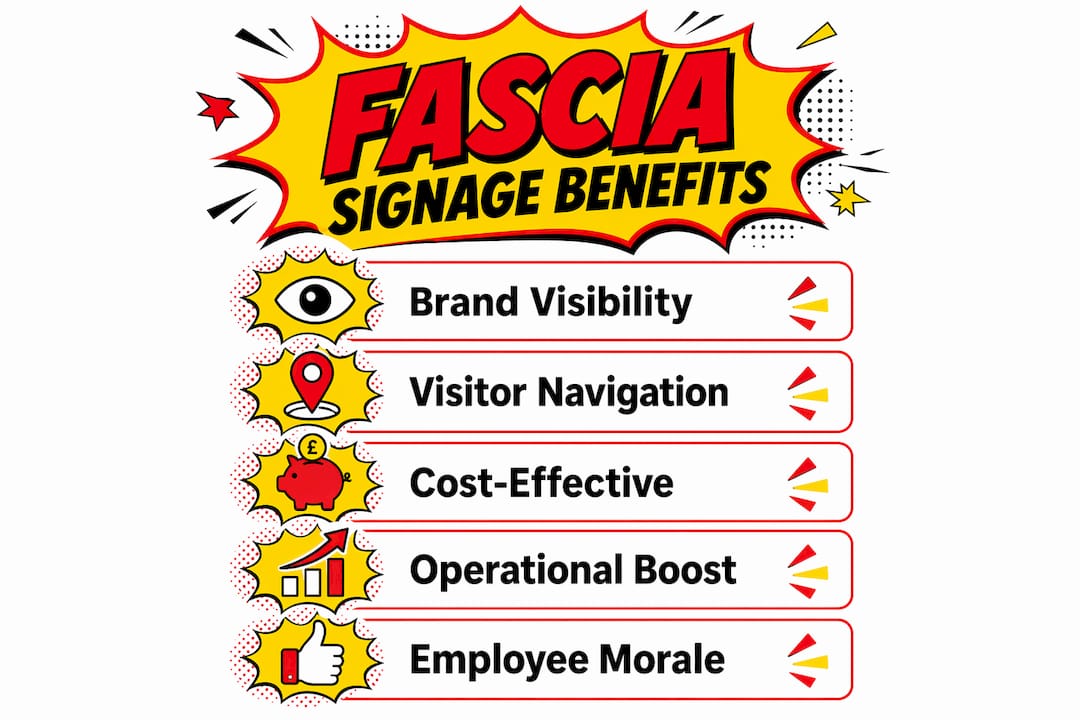
Clear fascia signage is the single most effective tool for reducing visitor confusion on arrival. When clients cannot find your office quickly, their first experience is frustration. That frustration colours every interaction that follows.
Effective signage placement and design supports visitor navigation and reduces friction from the moment someone approaches your building. The practical benefits are straightforward: a well-placed, legible sign removes uncertainty and replaces it with confidence. Clients who arrive calmly and on time are better prepared for productive meetings.
Wayfinding in multi-tenant office complexes presents a specific challenge. When several businesses share a building or business park, clear and consistent branding removes confusion and strengthens your distinct presence among adjacent businesses. Without a clear fascia sign, visitors default to guessing, which wastes time and creates a poor first impression.
Accessibility is a legal and ethical obligation, not an optional extra. The following steps make your fascia signage inclusive and compliant:
- Use high-contrast colour combinations. Dark text on a light background, or vice versa, is legible for visitors with visual impairments.
- Select an appropriate font size. Text must be readable from the distance at which visitors will first see your building.
- Consider tactile and braille elements. Accessible signage features such as braille and raised lettering support inclusivity and demonstrate social responsibility.
- Ensure logical placement. Mount signs at a height accessible to wheelchair users and at a position that aligns with natural sightlines.
- Maintain legibility at night. Illuminated signage serves visitors arriving outside daylight hours and supports year-round usability in the UK’s shorter winter days.
Pro Tip: Pair your external fascia sign with internal wayfinding signage to create a consistent journey from street to reception. Visitors who feel guided throughout their arrival experience a more professional and welcoming environment.
What are the marketing and operational benefits of quality external signage?
External fascia signage is one of the most cost-effective marketing tools available to any office-based business. It requires no subscription, no click budget, and no ongoing media spend. Once installed, it works every hour of every day.
Outdoor signage functions as a permanent advertisement that builds recognition over time. Every person who walks or drives past your building sees your brand. Over weeks and months, that repeated exposure builds familiarity, and familiarity builds trust. This compounding effect is something no short-term advertising campaign can replicate.
The operational benefits extend beyond marketing. Well-maintained signage reinforces organisational values and supports staff engagement. Employees who work in a well-presented building feel a greater sense of pride in their workplace. That pride translates into stronger performance and a more positive culture. The connection between a professional environment and employee morale is well established across commercial property research.
Poorly presented premises can lose contracts and fail recruitment. This is the risk that facilities managers and business owners rarely quantify, but it is real. A prospective client or senior hire who arrives at a building with a damaged or absent fascia sign draws immediate conclusions about the organisation’s standards.
| Benefit | Impact on your office |
|---|---|
| Continuous brand exposure | Your sign works 24 hours a day without additional spend |
| Client confidence | A professional sign builds trust before the first meeting |
| Employee morale | Well-presented premises increase staff pride and engagement |
| Footfall and recognition | Repeated visibility builds local brand familiarity over time |
| Recruitment impression | Candidates assess your organisation from the outside first |
How do you choose and maintain external fascia signage?
Material selection determines how long your fascia sign performs at a professional standard. External signage must endure the UK’s varied weather, including rain, wind, UV exposure, and temperature fluctuations across seasons. Choosing the wrong material results in premature fading, warping, or structural failure, all of which damage your brand’s credibility.
The most common weather-resistant materials for UK office fascia signs are aluminium composite panels, powder-coated steel, acrylic, and high-density foam board with protective coatings. Aluminium composite is particularly popular because it is lightweight, rigid, and resistant to corrosion. Acrylic suits illuminated lettering well, as it diffuses light evenly and holds colour over time. For guidance on installation requirements, the property signage installation guide covers the practical steps relevant to UK office environments.
Design choices directly affect how well your sign performs in real conditions. High-contrast colour combinations improve legibility in low light and overcast conditions, which are common across much of the UK. Sans-serif typefaces at sufficient scale read clearly from a distance. Avoid overly decorative fonts that reduce legibility at speed or in poor weather. For a structured approach to design decisions, the architectural signage checklist covers the criteria most relevant to office buildings.
Maintenance is not optional. Regular maintenance signals company pride and attention to detail that clients associate with high standards. A practical maintenance schedule includes cleaning the sign face quarterly, checking fixings and brackets twice a year, replacing failed lighting components promptly, and repainting or re-laminating surfaces when fading becomes visible. Neglected signage communicates neglect across the whole business.
| Material | Weather resistance | Best use case | Maintenance frequency |
|---|---|---|---|
| Aluminium composite | High | Flat fascia panels, large format | Annual inspection |
| Powder-coated steel | High | Structural frames, projecting signs | Bi-annual inspection |
| Acrylic | Medium to high | Illuminated lettering, cut-out logos | Quarterly cleaning |
| High-density foam board | Medium | Temporary or budget installations | Monthly inspection |
You also need to account for planning permission and building regulations. Many external signs require consent from your local planning authority, particularly in conservation areas or listed buildings. Factor this into your project timeline before committing to a design or installation date. The office art and workspace design considerations that affect interior environments apply equally to the exterior, where first impressions carry the greatest weight.
Fascia signage shapes office identity more than most businesses realise
At Pikpikpow, we have worked with businesses across retail, construction, commercial interiors, and the TV and film industry. One pattern appears consistently: the businesses that treat fascia signage as a foundational investment, rather than a finishing touch, perform better in client-facing situations.
The most common mistake we see is treating signage as the last item on a fit-out budget. By the time a business moves into a new office, the signage budget has often been reduced to cover cost overruns elsewhere. The result is a sign that does not reflect the quality of the business inside. Clients notice. They may not say anything, but the impression is formed.
Signage is a non-discretionary infrastructure investment, not an optional decoration. Facilities managers who understand this allocate signage budget early in the planning process, not at the end. They also build maintenance schedules into their annual facilities plan, treating the sign as they would any other critical building system.
My practical advice for any facilities manager considering a signage upgrade: start with a brand audit. Check whether your current fascia sign accurately reflects your organisation’s current identity. Then assess its physical condition. If either the brand alignment or the physical condition falls short, the case for investment is clear.
— PikPikPOW!
How Pikpikpow can support your office’s external fascia signage
Pikpikpow designs and manufactures bespoke external fascia signage for offices across the UK, combining design expertise with precision manufacturing to produce signs that perform in real conditions.
Whether you need a single illuminated fascia panel for a professional services firm or a full signage system for a multi-tenant commercial building, Pikpikpow handles design, production, and installation. Every project starts with a thorough brief to ensure the finished sign reflects your brand accurately and meets all relevant planning and safety requirements. You can also explore architectural signage options to see how external and internal signage can work together to create a consistent brand environment from street to reception.
Key takeaways
External fascia signage is a business-critical asset that shapes client trust, supports navigation, and delivers continuous brand exposure without ongoing advertising costs.
| Point | Details |
|---|---|
| First impressions are immediate | Visitors form opinions in seconds, making your fascia sign your most important client-facing asset. |
| Brand consistency builds trust | Your sign must align with your wider brand guidelines to communicate reliability and professionalism. |
| Accessibility is non-negotiable | High contrast, appropriate font size, and tactile features make your signage inclusive and compliant. |
| Material choice determines longevity | Weather-resistant materials such as aluminium composite and powder-coated steel perform best in UK conditions. |
| Maintenance protects your investment | Regular cleaning and structural checks preserve the professional appearance that clients and staff expect. |
FAQ
What is external fascia signage?
External fascia signage is a branded sign fixed to the exterior face of a building, typically above the entrance or at street level. It displays the business name, logo, and brand colours to identify the premises and communicate the organisation’s identity.
Why does fascia signage matter for office buildings?
Fascia signage shapes the first impression clients, visitors, and potential recruits form about your business. Well-maintained signage links directly to perceived credibility, with opinions formed within seconds of arrival.
What materials work best for UK office fascia signs?
Aluminium composite panels and powder-coated steel offer the highest weather resistance for UK conditions. Material selection is fundamental for maintaining a professional appearance through rain, wind, and UV exposure across all seasons.
Does office signage affect employee morale?
Yes. Professional signage reinforces organisational values and increases staff pride in their workplace. Employees in well-presented buildings consistently report stronger engagement with their organisation.
Do I need planning permission for an office fascia sign?
Most external signs require consent from your local planning authority, particularly in conservation areas or on listed buildings. Always check with your local council before commissioning a design or proceeding to installation.