
TL;DR:
- Office signage is essential to communicate new brand identity and ensure legal compliance during an office rebrand. It reinforces brand culture, improves navigation, and influences visitor and employee perceptions positively. Early planning and collaboration with signage specialists lead to a cohesive, durable, and compliant physical environment that supports brand integrity.
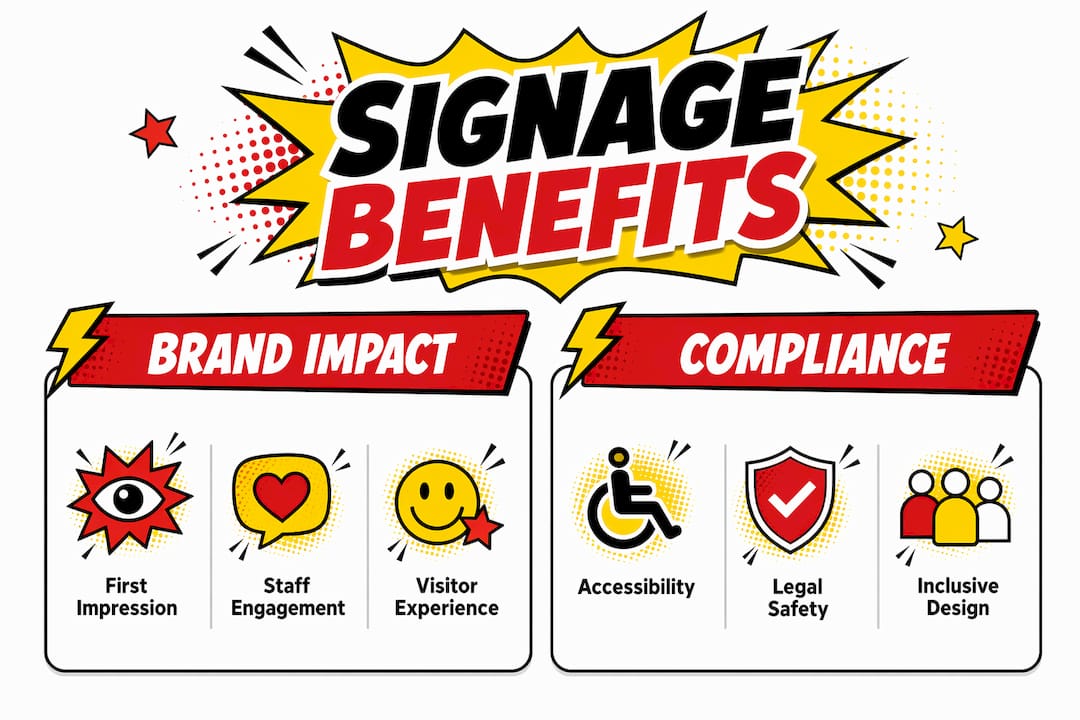
New office signage is a critical component of any successful rebrand, functioning as a visual language that communicates your updated brand identity to every person who enters your space. Signage is not a finishing touch. It is a foundational communication tool that embeds brand culture into physical environments. When a business changes its name, logo, colour palette, or values, the physical space must follow. This is why office rebrands require new signage: outdated signs create a direct contradiction between what your brand claims to be and what visitors and employees actually experience. UK regulations, including the Equality Act 2010 and BSI BS 8300-2 (2025), add legal weight to this requirement.
Why office rebrands require new signage: the core case
Signage is the first physical expression of your brand that anyone encounters. Before a client shakes your hand or reads your website, they read your walls, your reception fascia, and your wayfinding panels. Poor signage signals carelessness and damages brand trust in a way that no amount of digital marketing can quickly repair. That first impression is set within seconds, and it is set by your physical environment.

The industry term for this discipline is Environmental Graphic Design (EGD). EGD is the practice of integrating brand identity with architecture and spatial design to create a coherent, communicative environment. When you rebrand without updating your EGD, you leave a gap between your new identity and the space your clients and staff inhabit daily. That gap erodes credibility.
EGD is a strategic management tool that encodes organisational culture and behaviour, not merely decoration. This means your signage choices carry weight far beyond aesthetics. They tell a story about your values, your attention to detail, and your respect for the people who use your space.
How does signage reflect brand identity after a rebrand?
Brand identity lives in consistency. Your new logo, colour palette, and typography must appear across every touchpoint, and your office environment is one of the most powerful of those touchpoints. Signage consistency with brand colours, fonts, and messaging fosters coherence and trust among clients, employees, and visitors. Inconsistent signage undermines that clarity immediately.
Consider what integrated signage actually means in practice. It goes well beyond placing a new logo on the reception wall. It includes:
- Wayfinding panels using your updated typeface and colour system
- Room name plates finished in materials that match your brand’s character (brushed aluminium for a technical firm, warm timber for a creative agency)
- Wall graphics and murals that communicate your values or history
- Door and floor signage that carries the same visual language throughout
“Signage is not a finishing touch but a foundational communication tool embedding brand culture in physical spaces. When it is treated as an afterthought, the entire rebrand loses coherence.”
The impact on visitor and employee perception is measurable in practical terms. A client walking through a well-branded office feels they are dealing with an organised, credible business. An employee surrounded by signage that reflects the company’s values reports stronger cultural alignment and engagement. Motivational and branded signage contribute to a productive and aligned workforce. That is a direct return on your signage investment.
Pro Tip: Work with a brand identity specialist and your signage supplier at the same time. Evergreen Design Studio’s brand identity services can help you lock down the visual system before any physical production begins, which prevents costly reprints.
What are the legal requirements for office signage during a rebrand?
Updating your signage during a rebrand is not only a brand decision. It is a legal obligation. The UK Equality Act 2010 requires businesses to make reasonable adjustments to ensure their premises are accessible to all users, including those with visual impairments and neurodiverse conditions. Signage is explicitly part of that obligation.
The updated BSI standard BS 8300-2 (2025) sets specific requirements for tactile and acoustic wayfinding in commercial buildings. These requirements include:
- High-contrast lettering with a minimum luminance contrast ratio between text and background.
- Tactile characters and Braille on key wayfinding signs, including room identification and emergency exit panels.
- Non-reflective finishes to prevent glare for users with low vision.
- Consistent sign placement at standardised heights to support users with mobility aids.
- Clear pictograms that meet ISO 7010 standards for safety and wayfinding symbols.
Failure to comply can result in corporate liability and what regulators describe as “Brand Exclusion” penalties, where a business is found to have actively excluded a protected group from accessing its services. That is a reputational and financial risk that no rebrand budget should ignore.
The table below summarises the key compliance areas and what they require in practice.
| Compliance area | Requirement |
|---|---|
| Equality Act 2010 | Reasonable adjustments for accessibility across all signage |
| BSI BS 8300-2 (2025) | Tactile characters, Braille, and non-reflective finishes |
| ISO 7010 | Standardised pictograms for safety and wayfinding |
| Sign placement height | Consistent mounting heights for users with mobility aids |
| Luminance contrast | Minimum contrast ratio between text and background colour |
Accessibility-compliant signage also enhances brand inclusivity by ensuring all users, including neurodiverse and visually impaired individuals, can navigate and engage with your space intuitively. Compliance is not just about avoiding liability. It is about demonstrating that your brand genuinely serves everyone who walks through your door.
How does updated signage improve workplace experience?
New signage does more than look good. It directly improves how people move through and feel within your office. Integrated signage improves wayfinding, reduces visitor anxiety, and supports a frictionless workspace navigation experience. When visitors can find meeting rooms, toilets, and exits without asking for help, the entire interaction with your business starts on a confident footing.
Materials and lighting choices
The materials and lighting you choose for your signage affect the mood of your office as much as the furniture does. Architectural-grade materials such as brushed steel, acrylic, and solid timber communicate permanence and quality. Non-reflective finishes and embossed characters meet tactile reading standards while also creating a premium surface quality that cheap printed panels cannot replicate. Dynamic lighting, whether backlit lettering or LED-edged panels, adds depth and draws attention to key brand moments in the space.
The comparison below shows how material choices affect both perception and compliance.
| Signage type | Brand perception | Compliance benefit |
|---|---|---|
| Printed vinyl panels | Budget, temporary | Limited tactile support |
| Acrylic with raised lettering | Modern, professional | Tactile reading support |
| Brushed metal with Braille | Premium, authoritative | Full BS 8300-2 compliance |
| Illuminated fascia signs | High-impact, confident | Visibility in low light |
Environmental graphics and staff engagement
Environmental graphics, including wall murals and branded wayfinding, enhance brand visibility and staff engagement without requiring a full fit-out. Removable systems make this particularly practical for businesses in leased offices, where permanent installation may not be permitted. A well-placed wall mural in a breakout area, or a timeline of company milestones along a corridor, turns blank walls into brand assets. To understand how this works in depth, Pikpikpow’s guide on environmental graphics explains the full scope of what is possible.
Pro Tip: Plan your wayfinding system before you finalise your floor layout. Retrofitting signage around furniture and partitions always costs more and produces a less coherent result than designing both together.
What are the most common signage mistakes during office rebrands?
The most damaging mistake businesses make during a rebrand is treating signage as the last item on the budget. By the time the fit-out is complete, funds are often depleted, and signage gets reduced to cheap printed panels that contradict the quality of everything else in the space. A documented example of this pattern involved a £2.5 million office fit-out that failed due to poor signage, leaving staff uninspired and clients confused about the company’s identity. The investment in the physical space was wasted because the signage did not carry the brand through it.
Other common pitfalls include:
- Using inconsistent materials across floors or departments. A brushed steel reception sign paired with printed paper room labels on the same floor sends a contradictory message about brand standards.
- Ignoring navigational logic. Signage placed at eye level in a corridor is useless if it appears after the decision point, where a visitor has already chosen the wrong direction.
- Skipping accessibility requirements. Businesses that do not update signage to meet BS 8300-2 (2025) face legal exposure and exclude a significant portion of their audience.
- Failing to brief the signage supplier on the full brand system. Supplying only a logo file without colour references, typeface specifications, and material preferences results in signage that looks close but not correct.
- Treating digital and physical signage as separate projects. A digital signage screen in reception that displays the old logo while the new fascia sign is already installed creates an immediate credibility problem.
Poor signage before or after a rebrand conveys a message of neglect, harming brand reputation and trust. The fix is not expensive if planned early. It becomes expensive only when it is left until the end.
Key takeaways
Office rebrands require new signage because signage is the primary physical expression of brand identity, and outdated signs directly contradict the message a rebrand is designed to send.
| Point | Details |
|---|---|
| Signage is a legal requirement | The Equality Act 2010 and BSI BS 8300-2 (2025) mandate accessible, compliant signage in commercial offices. |
| EGD encodes brand culture | Environmental Graphic Design embeds values and identity into the physical space, not just the logo. |
| Materials affect perception | Architectural-grade materials signal quality and permanence; cheap panels undermine the entire rebrand. |
| Plan signage early | Retrofitting signage after a fit-out costs more and produces weaker results than integrating it from the start. |
| Poor signage damages trust | Inconsistent or outdated signage signals carelessness and erodes client and employee confidence. |
Signage strategy: what we have learned from office rebrands
At Pikpikpow, we have worked on enough office rebrands to know where the process breaks down. It almost always breaks down at the same point: the signage brief arrives after the contractor has finished, the budget has been spent, and the client is under pressure to open the space. At that stage, the signage becomes a compromise rather than a statement.
The businesses that get this right treat signage as part of the design brief from day one. They bring their signage supplier into conversations alongside the architect and the interior designer. That early collaboration is what allows the wayfinding system to be logical, the materials to be consistent, and the brand to feel genuinely embedded in the space rather than applied to it afterwards.
There is also a tendency to underestimate what signage does for staff. Employees who work in a space that visually reflects the company’s values report stronger engagement with the brand. That is not a soft benefit. It affects retention, productivity, and how staff represent the business externally. Investing in quality branded wayfinding is an investment in your people as much as your premises.
The uncomfortable truth is that signage is one of the few elements of an office rebrand that every single person who enters the building will notice and judge. Get it right, and it reinforces everything else you have invested in. Get it wrong, and it undermines it.
— PikPikPOW!
Pikpikpow’s signage solutions for office rebrands
Pikpikpow specialises in bespoke signage systems designed for commercial office environments across the UK. Whether you need a full wayfinding system, architectural fascia signs, or environmental graphics that bring your new brand to life on the wall, Pikpikpow delivers solutions that meet both your brand specification and UK accessibility standards.
Our signage systems cover everything from reception lettering and room identification panels to large-format wall graphics and compliant tactile signage. We work directly with your brand guidelines to produce signage that is consistent, durable, and built to last beyond the initial excitement of a rebrand. If you are planning an office rebrand and want signage that works as hard as the rest of your investment, speak to the Pikpikpow team today.
FAQ
Why does a rebrand require new office signage?
A rebrand changes your visual identity, and your physical signage is the most visible expression of that identity in your workspace. Outdated signage directly contradicts the message your rebrand is designed to send.
What UK laws apply to office signage?
The Equality Act 2010 requires accessible signage as a reasonable adjustment for disabled users. BSI BS 8300-2 (2025) sets specific standards for tactile characters, Braille, contrast ratios, and sign placement in commercial buildings.
How does signage affect employee engagement?
Branded signage that reflects company values contributes to a more aligned and productive workforce. Employees who work in a visually coherent environment report stronger cultural engagement with the business.
What is Environmental Graphic Design?
Environmental Graphic Design (EGD) is the practice of integrating brand identity with architecture and spatial design. It covers wayfinding, wall graphics, and all signage that communicates brand culture within a physical space.
When should signage be planned in an office rebrand?
Signage should be planned at the same time as the architectural and interior design brief. Retrofitting signage after a fit-out is completed costs more and produces less coherent results than integrating it from the outset.