
TL;DR:
- A poolside signage system includes durable, strategically placed signs that communicate safety rules, regulations, emergency instructions, and guest guidance. Proper design, placement, and maintenance in compliance with UK standards are essential for safety, legal protection, and effective communication. Regular inspections and durable materials ensure signs remain functional and help prevent accidents and liability.
A poolside signage system is defined as an integrated set of durable, strategically placed signs that communicate safety rules, pool regulations, emergency instructions, and guest guidance around swimming pools. Property managers and business owners operating recreational facilities have a legal duty to deploy such systems under HSE guidance HSG 179, updated to 2026, and the design standard BS EN 15288-1:2018. Getting this right is not optional. Poorly designed or maintained pool area information signs expose your facility to liability, regulatory penalties, and, most seriously, preventable accidents.
What is a poolside signage system and what does it include?
A poolside signage system is the complete collection of signs, floor markings, and placards positioned around a pool perimeter to inform, instruct, and protect every user. The industry term used by the Health and Safety Executive is “safety signs and signals,” governed by The Health and Safety (Safety Signs and Signals) Regulations 1996. Both terms describe the same concept: a coordinated visual communication system that works as a whole, not a collection of individual notices.
Poolside signage categories fall into three distinct types: regulatory, informational, and emergency. Each type serves a different purpose, and a complete system requires all three working together.
- Regulatory signs prohibit dangerous actions. Common examples include no diving, no running, no heavy petting, and maximum bather capacity notices. These signs carry legal weight and must use internationally recognised symbols under BS EN ISO 7010 to remain clear to guests of all languages and literacy levels.
- Informational signs provide pool area information that helps users make safe decisions. Depth markers are the most critical example. Depth markers should be visible every 25 feet along the pool edge, and pool rules boards summarise conduct expectations in a single location.
- Emergency signs identify alarm points, first aid equipment locations, emergency phone instructions, and evacuation routes. These must be immediately visible from any position in the pool area, not tucked behind equipment or obscured by other notices.
- Floor markings and placards complete the system. Tactile markings at pool edges, lane markers, and depth indicators on pool walls extend the signage system below and around the water line, creating a fully integrated safety environment.
Using internationally recognised symbols throughout the system is not simply good practice. It is a legal requirement under the 1996 Regulations, which harmonise UK signage with EU standards and BS EN ISO 7010, ensuring clarity for all guests regardless of background.
Which regulations and standards govern poolside signage in the UK?
UK pool signage compliance sits within a clear legal framework. Property managers must understand three overlapping layers of regulation to avoid liability.
| Regulation or standard | What it covers | Who enforces it |
|---|---|---|
| HSE guidance HSG 179 | Operational safety management for public pools, including signage requirements | Health and Safety Executive |
| BS EN 15288-1:2018 | Design and operational standards for swimming pools, including signage specifications | British Standards Institution |
| The Health and Safety (Safety Signs and Signals) Regulations 1996 | Legal requirements for all workplace safety signs, including prohibited actions, hazards, and emergency directions | Health and Safety Executive |
| BS EN ISO 7010 | Internationally recognised graphical symbols for safety signs | British Standards Institution |
HSG 179 is the primary operational guide for commercial pool operators. Operators are legally required to manage pool safety with effective, legible signage that warns of hazards and instructs users. This is not a recommendation. It is a statutory duty.
The Health and Safety (Safety Signs and Signals) Regulations 1996 set the baseline for every sign in your facility. Signs must be clear, legible, and compliant with these regulations, which align UK practice with EU standards. The regulations specify colour coding, symbol use, and the categories of information each sign type must convey.
BS EN 15288-1:2018 goes further by setting design and operational standards specific to swimming pools. Compliance audits for commercial pools must align with this standard, covering everything from sign dimensions to placement heights. Failing an audit under this standard can result in enforcement action, facility closure, or both.
The legal risk of inadequate signage is direct. Failing to maintain signage exposes operators to liability and regulatory penalties. A single incident linked to a missing or illegible sign can result in prosecution, civil claims, and reputational damage that far outweighs the cost of a proper signage system.
How to design and maintain an effective poolside signage system
Designing an effective system starts with placement. Most facilities make the mistake of clustering signs at the entrance and assuming the job is done. That approach fails.
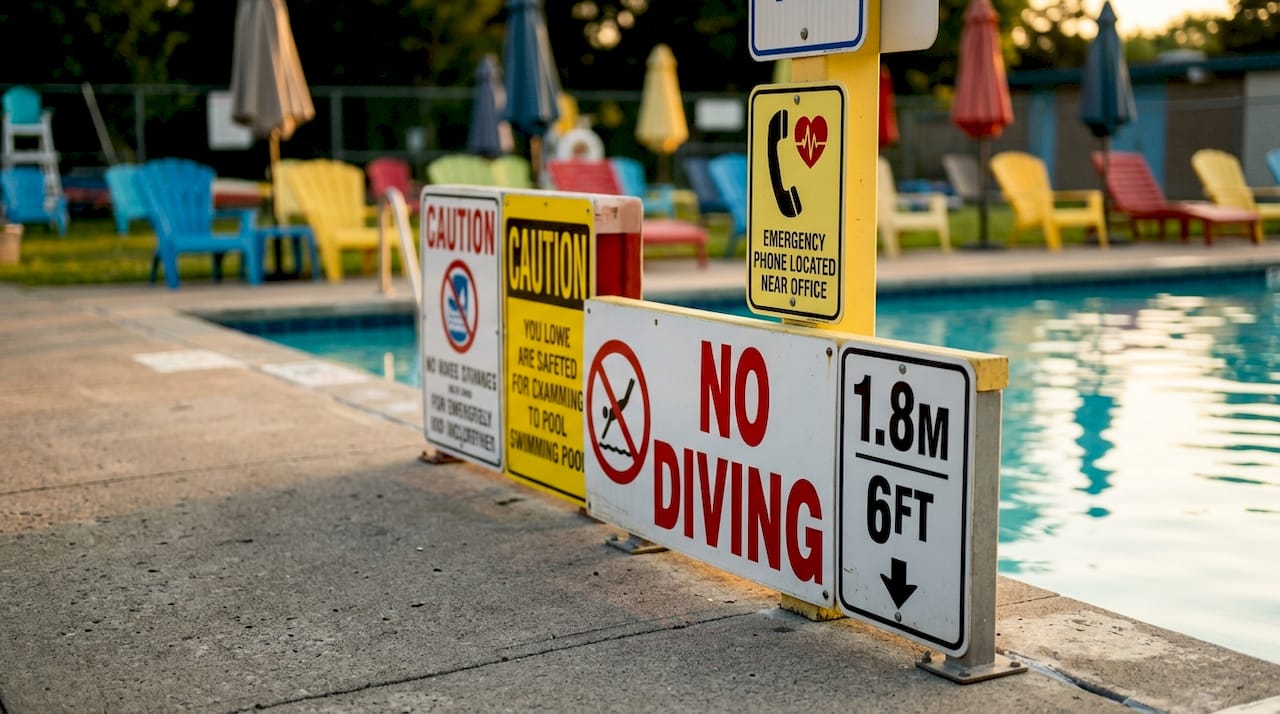
Signs must be positioned at hazard points such as diving boards, chemical storage areas, and pool edges, and along key sight lines throughout the pool area. Eye-level placement at each hazard point maximises the chance that a user reads the sign at the moment it matters most.
Material and durability
Outdoor pool environments are hostile to standard signage materials. UV exposure, chlorine vapour, humidity, and physical contact from wet users all degrade signs quickly. Specify materials rated for outdoor and chemical environments: rigid PVC, aluminium composite, or marine-grade substrates. Printed graphics must use UV-resistant inks or be protected by anti-graffiti laminates. A sign that fades within one season is not compliant and not safe.
Messaging and behaviour
RoSPA advises that signage systems should shape guest behaviour with positive reinforcement, not only prohibit actions. A sign reading “Walk to stay safe” works alongside “No running” to actively promote safer conduct. This dual approach, instructive alongside prohibitive, produces better behavioural outcomes than prohibition alone.
Maintenance and inspection
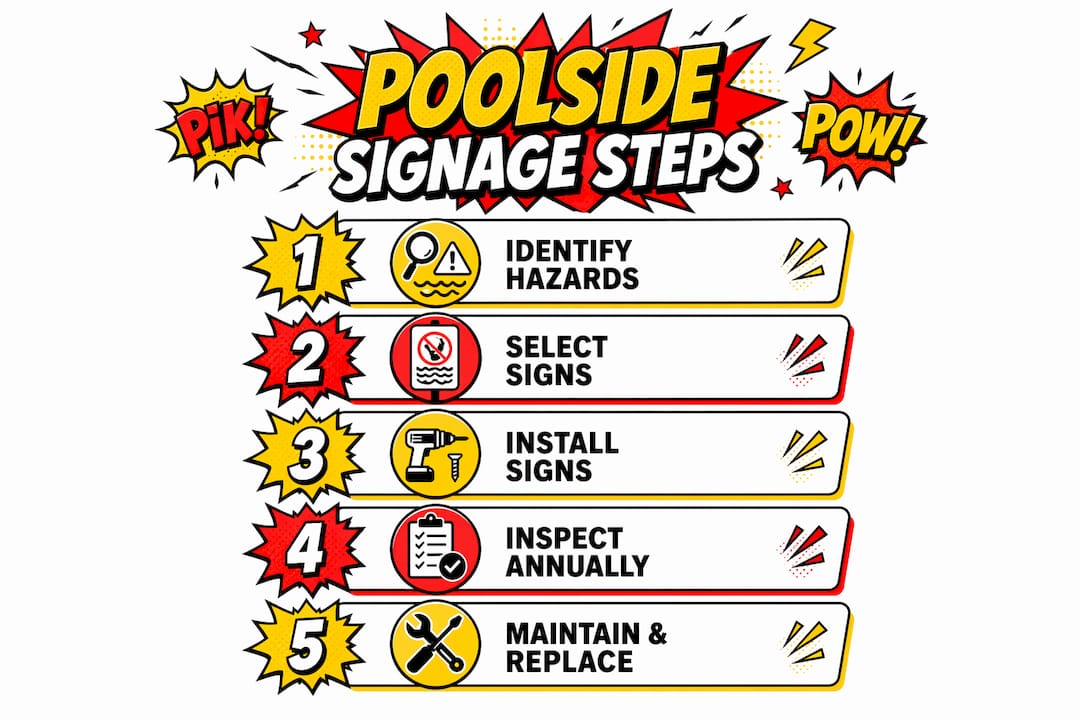
- Inspect every sign at least annually, and after any facility change or incident.
- Log each inspection with the date, inspector name, and any issues found.
- Replace damaged, faded, or illegible signs immediately. A sign that cannot be read offers no protection.
- Include signage in your formal risk assessment as a named component of the pool’s safety management system.
- Review sign relevance when pool rules, bather capacity limits, or pool layout change.
Pro Tip: Create a simple signage register listing every sign in your facility, its location, material, and last inspection date. This single document can demonstrate compliance during an HSE audit and dramatically reduces the risk of overlooking a damaged sign.
Avoiding sign clutter is as important as having enough signs. HSE guidance explicitly warns against sign clutter, which reduces the impact of every individual notice. Prioritise the signs that address the highest-risk behaviours and locations. A well-structured sports facility signage approach applies the same logic: fewer, better-placed signs outperform a wall of notices every time.
What are the benefits of an effective poolside signage system?
A well-designed pool signage system delivers measurable benefits across safety, compliance, and operations. Property managers who treat signage as a live safety tool rather than a one-off installation see the difference clearly.
Reduced accident risk. Clear pool signage improves guest safety and reduces the likelihood of accidents. Depth markers prevent diving injuries. No-running signs reduce slip incidents. Emergency signs cut response times when incidents do occur.
Legal compliance and reduced liability. A documented, maintained signage system demonstrates due diligence. If an incident occurs and you can show that compliant, legible signs were in place and regularly inspected, your liability position is significantly stronger.
Clear communication to diverse users. Pools serve guests of all ages, languages, and abilities. Internationally recognised symbols under BS EN ISO 7010 communicate rules without relying on language. Pictogram-based signs are accessible to children, tourists, and users with reading difficulties.
Professional perception. Well-designed signage fosters a professional pool environment. Guests notice when a facility is well-managed. Consistent, high-quality custom pool signage solutions signal that the operator takes safety and guest experience seriously.
Operational support for staff. Lifeguards and pool staff cannot be everywhere at once. Clear, authoritative signs reinforce rules continuously, reducing the number of verbal interventions staff must make and allowing them to focus on active supervision.
The ultimate goal of poolside signage is behavioural influence: actively guiding users towards safer conduct, not simply satisfying a compliance checklist. Facilities that understand this distinction build safer environments and stronger reputations.
For property managers reviewing their safety signage compliance, the benefits of getting this right extend well beyond avoiding fines. They include fewer incidents, lower insurance risk, and a guest experience that builds trust.
Key takeaways
A poolside signage system is a legally required, actively managed safety tool that protects guests, supports staff, and shields operators from liability when designed, placed, and maintained to HSG 179 and BS EN 15288-1:2018 standards.
| Point | Details |
|---|---|
| Three sign categories | Every system needs regulatory, informational, and emergency signs working together. |
| Placement over quantity | Signs belong at hazard points and sight lines, not clustered at entrances. |
| Maintenance is mandatory | Inspect annually, log every check, and replace damaged signs immediately. |
| Behaviour-shaping messaging | Combine prohibitive and instructive signs to actively promote safer conduct. |
| Compliance reduces liability | A documented, maintained system demonstrates due diligence during audits and incidents. |
What we have learned from managing poolside signage projects
Property managers consistently underestimate one thing: signage is not a one-time purchase. The facilities that get into trouble are almost always the ones that installed compliant signs at opening and never reviewed them again. Faded depth markers, peeling no-diving notices, and missing emergency phone instructions are not edge cases. They are the norm in facilities that treat signage as infrastructure rather than as a live safety tool.
The shift in thinking that makes the biggest difference is treating your signage register the same way you treat your pool chemical log. Both require regular checks. Both carry legal weight. Both protect your guests and your business. The moment you integrate signage into your formal risk assessment and safety management system, the maintenance discipline follows naturally.
One thing that often surprises property managers is how much positive, instructive messaging improves guest behaviour compared to prohibition-only signs. Facilities that replace half their “no” signs with instructive equivalents report noticeably fewer verbal interventions from staff. The signs do the work.
Finally, material choice matters more than most managers realise at the specification stage. Cheap signage that degrades within 18 months costs more over five years than a properly specified, durable system installed once. Specify for the environment from the outset, and your signage system will hold up through seasons of chlorine, UV, and heavy use.
— PikPikPOW!
Pikpikpow’s poolside signage solutions for property managers
Pikpikpow specialises in bespoke outdoor signage built to perform in demanding environments, including commercial pool areas where durability, legibility, and compliance are non-negotiable.
Our signage systems cover the full range of poolside requirements: regulatory signs, depth markers, emergency notices, and custom pool signage solutions designed to meet HSG 179 and BS EN 15288-1:2018 standards. Every sign is produced using materials specified for outdoor and chemical environments, with UV-resistant finishes that maintain legibility through years of heavy use. We work directly with property managers and business owners to design systems that are clear, compliant, and built to last. Contact Pikpikpow to discuss your facility’s requirements and get a signage system that works as hard as your team does.
FAQ
What is a poolside signage system?
A poolside signage system is an integrated set of regulatory, informational, and emergency signs placed around a swimming pool to communicate safety rules, pool information, and emergency instructions to all users. It must comply with HSE guidance HSG 179 and BS EN 15288-1:2018.
Which UK regulations apply to pool signage?
The Health and Safety (Safety Signs and Signals) Regulations 1996, HSE guidance HSG 179, and BS EN 15288-1:2018 all apply. Signs must also use internationally recognised symbols under BS EN ISO 7010.
How often should poolside signs be inspected?
Signs should be inspected at least annually and after any facility change or incident. Inspections must be logged, and damaged or illegible signs replaced immediately to maintain compliance.
What are the most common poolside signs required?
The most common signs include no diving, no running, depth markers, maximum bather capacity notices, emergency phone instructions, and first aid location signs. Depth markers should be visible every 25 feet along the pool edge.
Can signage really reduce accidents at pools?
Yes. Clear, well-placed pool signage reduces accident risk by communicating hazards at the point of risk and actively shaping guest behaviour. RoSPA confirms that instructive signs, not only prohibitive ones, produce measurably safer conduct.