

TL;DR:
- Choosing outdoor signage involves matching sign type, material, and design to your location and audience to maximize visibility and brand recognition. Proper assessment of site obstructions, material durability, legibility, and compliance with local regulations ensures the sign performs effectively from day one. Planning maintenance, selecting high-quality materials, and considering digital options can extend sign lifespan and improve ongoing business impact.
Outdoor signage selection is a strategic process that determines how visible, credible, and recognisable your business becomes to passing customers. The right sign type, material, design, and placement work together to attract foot traffic, reinforce brand identity, and guide customers to your door. Get any one of these factors wrong and you risk wasted spend, poor visibility, or even a fine from your local council. This guide covers every decision point, from location analysis and material selection to design legibility and regulatory compliance, so you can commission signage that performs from day one.
How to choose outdoor signage: start with location and audience
Your physical location is the single most important factor in selecting the right sign type. A business on a fast A-road needs a completely different solution to one tucked inside a pedestrian shopping centre. Sign type should match viewer distance and speed: pole or pylon signs attract motorists from distance, while blade signs and fascia signs suit pedestrians moving at walking pace.
Consider the following when assessing your location:
- Motorway or A-road frontage: Pylon signs and monument signs are the standard choice. They provide height, scale, and visibility from 50 metres or more.
- High street or retail parade: Fascia signs, projecting blade signs, and illuminated box signs perform well here. Pedestrians have time to read detail.
- Business park or industrial estate: Monument signs at the entrance create a prestigious presence. Directional signs within the site guide visitors efficiently.
- Shopping centre or covered mall: Lightbox signs and hanging signs work within landlord restrictions. Always check the centre’s signage policy before commissioning.
Visibility obstructions are a common and costly oversight. Trees, parked vehicles, street furniture, and building angles can all block sightlines. On-site visibility studies confirm line of sight, identify obstructions, and determine the optimal sign height and angle for your specific environment. Skipping this step is one of the most frequent causes of underperforming signage.
Pro Tip: Walk your site at different times of day and from multiple approach directions before finalising sign placement. What looks clear at noon may be obscured by parked delivery vehicles at 8am.
What are the best outdoor signage materials for durability?
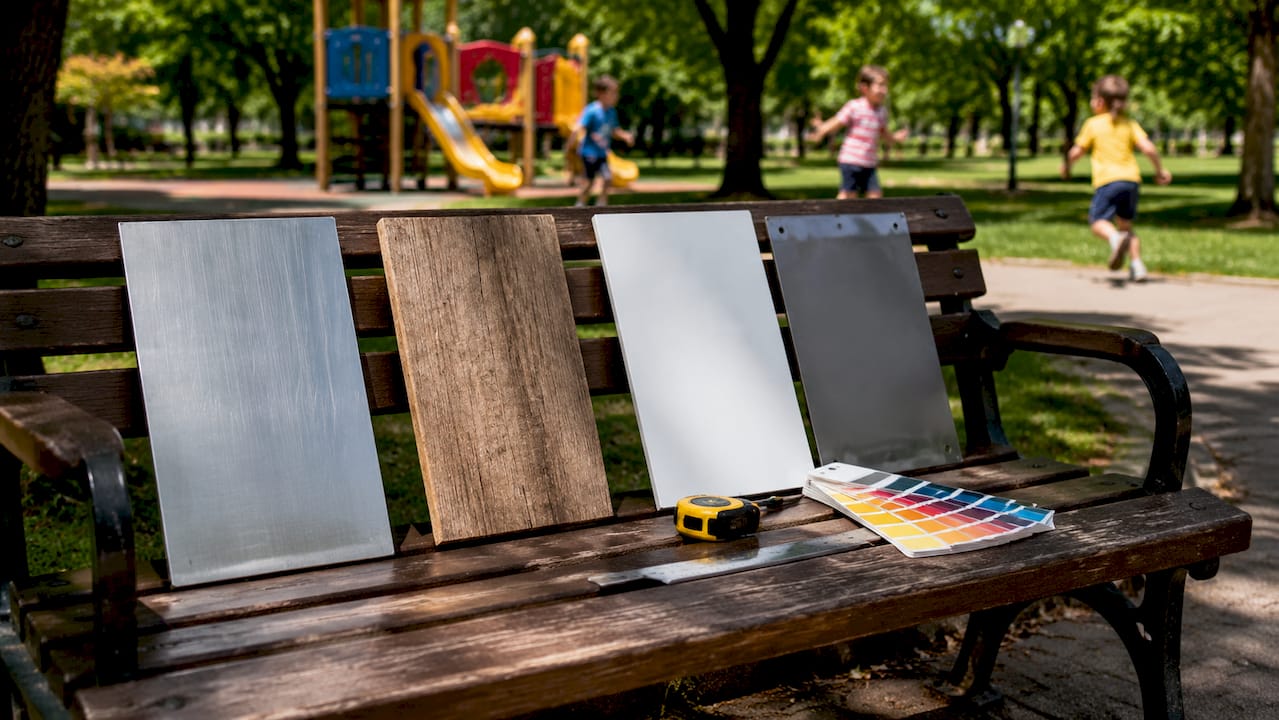
Material choice directly affects how long your sign lasts, how much maintenance it requires, and how it represents your brand. The most durable outdoor materials are aluminium, stainless steel, and HDPE, each suited to different budgets and environments.
| Material | Durability | Best For | Considerations |
|---|---|---|---|
| Aluminium | High | Most outdoor applications | Lightweight, cost-effective, corrosion-resistant |
| Stainless Steel | Very High | Coastal or high-humidity sites | Heavier and more expensive than aluminium |
| HDPE | High | Routed or dimensional signs | Resistant to moisture and UV degradation |
| Acrylic | Medium | Illuminated face panels | Can yellow over time without UV-stable grades |
| PVC | Low | Temporary or short-term use | Warps and fades under prolonged UV exposure |
| Wood | Low | Heritage or rustic aesthetics | Requires regular sealing; not suited to permanent outdoor use |
Aluminium is the default choice for most UK businesses. It balances affordability, low weight, and resistance to rust, making it practical for fascia signs, post-mounted signs, and flat-cut lettering. Stainless steel is the preferred option for coastal locations where salt air accelerates corrosion. For businesses near the sea, the additional cost of stainless steel pays for itself in reduced replacement frequency.
Wood and PVC are worth avoiding for permanent signage. Both degrade under UV exposure and wet weather, which is a significant concern across most of the UK. If your brand requires a natural or heritage aesthetic, consider aluminium with a wood-effect finish or a composite material with a UV-protective coating. Understanding why durable signage matters for your brand reputation is as important as understanding the material specs themselves.
Pro Tip: Always specify UV-stable inks and powder-coated or anodised finishes on aluminium signs. These add minimal cost but significantly extend the lifespan of printed graphics and colour finishes.
How do you design outdoor signage for legibility and brand consistency?
Legibility is the primary function of any outdoor sign. A sign that looks attractive in a design file but cannot be read from the pavement has failed its purpose. Viewing distance determines letter height: letters should be at least 5 inches tall per 50 feet of viewing distance. A sign read from 100 feet away requires letters at least 10 inches tall to be legible at a glance.
Follow these design principles to maximise impact:
- Contrast is non-negotiable. Light text on a dark background, or dark text on a light background, outperforms low-contrast combinations in all lighting conditions. Avoid mid-tone combinations like grey on white.
- Limit your message. A business name, a single descriptor, and a contact detail or website address is the maximum for most outdoor signs. Every additional element reduces reading speed.
- Choose fonts carefully. Sans-serif typefaces such as Helvetica, Gill Sans, or similar clean fonts read faster at distance than decorative or script typefaces. Stick to one or two font weights.
- Maintain brand consistency. Your outdoor sign should use the same colour palette, typeface, and logo treatment as your other brand materials. Inconsistency undermines credibility.
- Plan for night-time visibility. LED illumination, halo-lit lettering, and lightbox signs extend your sign’s working hours. For retail and hospitality businesses, illuminated signage is rarely optional.
Common design pitfalls include overcrowding the sign face with too much text, using brand colours that lack sufficient contrast, and scaling a logo-heavy design that works on screen but loses detail at distance. Always review your design at the intended viewing distance before approving production.
What local signage regulations must you check before installing?
Regulatory compliance is the most frequently overlooked step in the signage process. Local zoning and planning rules govern sign size, height, placement setbacks, illumination brightness, and in some cases, colour. Non-compliant signs face removal orders or financial penalties, and the cost of reinstallation far exceeds the cost of getting it right first time.
Key compliance factors to check before commissioning any sign:
- Permitted Development Rights: Many standard fascia signs and non-illuminated signs fall within permitted development in England, but this varies by location, listed building status, and conservation area designation.
- Advertisement Consent: Illuminated signs, projecting signs, and signs above a certain size typically require formal advertisement consent from your local planning authority.
- Size and height restrictions: Maximum sign dimensions are set by local codes and vary significantly between authorities.
- Brightness limits: Digital and illuminated signs are subject to brightness caps, particularly in residential areas or near roads.
- Landlord and lease restrictions: If you rent your premises, your lease may restrict sign types, fixing methods, or require landlord approval.
Engaging with local authorities early is the most reliable way to avoid costly mistakes. A reputable signage supplier can assist with compliance checks and, in many cases, manage the consent application on your behalf. For construction sites specifically, signage requirements also intersect with safety and compliance obligations that go beyond standard planning rules.
Traditional vs digital outdoor signage: which is right for you?
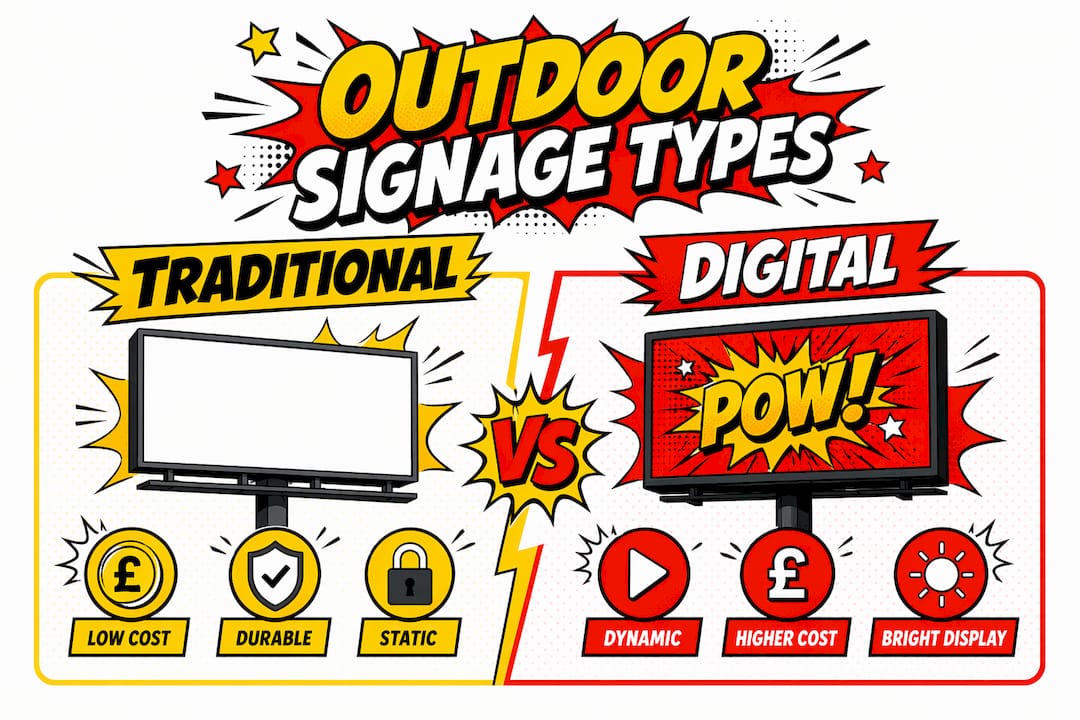
Traditional and digital outdoor signs serve different business needs, and the right choice depends on your budget, message frequency, and location. Traditional signs, including illuminated fascia signs, post-mounted signs, and lightboxes, offer lower upfront cost, proven durability, and minimal ongoing maintenance. Digital signs offer the ability to change content instantly, display multiple messages, and attract attention through motion.
| Factor | Traditional Signage | Digital Signage |
|---|---|---|
| Upfront cost | £500–£8,000 typical range | £2,500 to £20,000+ |
| Content flexibility | Fixed; requires physical replacement | Fully dynamic; update remotely |
| Maintenance | Low; periodic cleaning and bulb checks | Higher; screens, software, and connectivity |
| Brightness requirement | N/A | 2,000–3,500 nits minimum for sunlight legibility |
| Weather protection | Material-dependent | IP65 rating minimum required |
| Best for | Brand presence, wayfinding, permanent messaging | Promotions, menus, events, high-footfall locations |
Digital signage delivers the strongest return on investment in high-footfall locations where dynamic content drives purchasing decisions, such as food and beverage outlets, retail forecourts, and entertainment venues. IP ratings below IP65 frequently cause early screen failure in outdoor installations. Specify IP65 or higher for any screen exposed to rain or dust. Three-year warranties are standard for quality outdoor digital displays, and you should treat anything shorter as a red flag. Pikpikpow’s outdoor digital signage range is specified to meet these requirements, with options across a range of screen sizes and brightness levels.
Pro Tip: For digital signs in direct sunlight, specify 3,500 nits rather than the minimum 2,000. The additional brightness cost is modest compared to the visibility improvement on a south-facing installation.
Key takeaways
Choosing outdoor signage effectively requires matching sign type, material, and design to your specific location, audience, and compliance environment before a single penny is spent on production.
| Point | Details |
|---|---|
| Match sign type to location | Pylon signs suit motorists; fascia and blade signs suit pedestrians in retail settings. |
| Prioritise durable materials | Aluminium suits most UK sites; stainless steel is the right choice for coastal environments. |
| Design for legibility first | Use 5 inches of letter height per 50 feet of viewing distance and high-contrast colour combinations. |
| Check compliance before ordering | Confirm planning consent, size limits, and brightness caps with your local authority before commissioning. |
| Specify IP65 for digital signs | Any outdoor digital display without IP65 protection risks early failure from moisture and dust ingress. |
What we have learned from years of outdoor signage projects
The most common mistake we see from businesses commissioning outdoor signage is treating it as a design exercise rather than a visibility exercise. A sign can look excellent in a PDF and be completely ineffective on site. We have seen this happen repeatedly when clients select signs from catalogue images without accounting for the actual environment: the angle of approach, the competing visual noise, the shadows cast by adjacent buildings in the afternoon.
Signage is a functional business asset aligned to specific objectives. Before you think about colours or materials, you should be asking: what do I want this sign to achieve? Is it attracting passing trade, confirming your location to customers who already know you, or reinforcing brand credibility to visitors? Each objective points to a different sign type and placement strategy.
We also see businesses underestimate the importance of maintenance planning from the outset. A sign with no planned maintenance access becomes expensive to service within a few years. Weatherproof seals, accessible fixing points, and modular face panels are worth specifying at the design stage, not as an afterthought. The businesses that get the most from their signage investment are those that treat it as infrastructure, not decoration. They plan for a ten-year lifespan, not a two-year one. That mindset changes every decision in the process, from material grade to illumination type to how the sign is fixed to the building. You can also explore how to maintain outdoor signs to understand what a realistic upkeep schedule looks like before you commit to a specification.
— Pikpikpow
How Pikpikpow can help you get your outdoor signage right
Pikpikpow works with businesses across retail, construction, and commercial sectors to deliver outdoor signage that performs in the real world, not just on screen. From initial site assessment and design through to fabrication and installation, we manage the full process so you are not left coordinating between multiple suppliers.
Our signage systems range covers everything from illuminated fascia signs and post-mounted displays to fully specified digital signage solutions built to IP65 and above. We also handle compliance checks and can advise on advertisement consent requirements for your specific location. If you are ready to move from planning to production, speak to the Pikpikpow team and we will help you select the right solution for your site, budget, and brand.
FAQ
What type of outdoor sign works best for a roadside business?
Pylon or pole signs are the standard choice for roadside businesses, as they provide the height and scale needed to attract motorists from distance. Monument signs are an alternative where height restrictions apply, offering a prestigious ground-level presence.
How do i select the right material for an outdoor sign?
Aluminium is the most practical choice for most UK outdoor signs, offering durability, low weight, and corrosion resistance at a reasonable cost. For coastal or high-humidity sites, stainless steel provides superior protection against salt air and moisture.
Do i need planning permission for an outdoor business sign?
Many standard fascia signs fall within permitted development rights in England, but illuminated signs, projecting signs, and larger formats typically require advertisement consent from your local planning authority. Always confirm requirements with your council before ordering.
What brightness does an outdoor digital sign need?
Outdoor digital signs require a minimum brightness of 2,000–3,500 nits to remain legible in direct sunlight. South-facing or high-sunlight installations should be specified at the higher end of this range.
How long should a quality outdoor sign last?
A well-specified aluminium or stainless steel sign with UV-stable finishes should last 10 years or more with basic maintenance. Digital signs typically carry three-year warranties, with screen lifespan dependent on operating hours and environmental conditions.