
TL;DR:
- Health and safety signage uses standardized visual symbols to warn of hazards, direct actions, and ensure emergency responses. UK regulations mandate clear, Pictogram-based signs in workplaces where risks persist, promoting rapid understanding across language barriers. Proper signage placement, maintenance, and employee training are essential to effectively reduce workplace accidents and meet legal requirements.
Health and safety signage is the standardised system of visual signs used in workplaces to communicate hazards, mandatory actions, and emergency information instantly, without relying on text alone. These signs use specific colours, shapes, and pictograms governed by the UK Health and Safety (Safety Signs and Signals) Regulations 1996 and international frameworks such as ISO 7010. Every business operating in the UK has a legal duty to display appropriate signs wherever significant risks remain after other control measures have been applied. Get this wrong and you face regulatory penalties, increased liability, and, more critically, preventable accidents.
What is health and safety signage and why does it matter?
Health and safety signage refers to the complete set of standardised visual communications displayed in workplaces to warn of hazards, direct safe behaviour, and guide emergency responses. The Health and Safety Executive (HSE) defines these signs as a requirement wherever risks persist after engineering controls and safe working procedures have been put in place. Signage is not a substitute for removing hazards. It is the final safety layer once all other controls have been exhausted.

The reason pictograms dominate this system is grounded in how the human brain works. Visual signals are processed 600,000 times faster than text, which means a well-designed sign communicates danger before a worker has finished reading a single word. That speed is the entire point. In a factory, on a construction site, or in a hospital corridor, a fraction of a second can determine whether someone avoids an injury or suffers one.
Beyond speed, signage addresses language diversity. A workforce that includes speakers of Polish, Romanian, Punjabi, and English cannot rely on text-only warnings. Signs designed for instant comprehension without words serve every worker equally, which is why pictogram-based design is both a practical necessity and a legal expectation under UK regulations.
Why use safety signage: legal obligations and practical benefits
The Health and Safety (Safety Signs and Signals) Regulations 1996 impose a clear legal duty on UK employers. Signs must be clear, legible, and deployed only where significant risks remain despite other controls. Failure to comply exposes businesses to HSE enforcement action, improvement notices, fines, and civil liability if an accident occurs where signage was absent or inadequate.
Beyond legal compliance, the practical benefits of a well-implemented signage system are substantial:
- Rapid hazard recognition. Workers identify risks in under two seconds when signs follow standard colour and shape conventions.
- Language barrier reduction. Pictogram-based signs communicate across multilingual workforces without translation costs or delays.
- Improved safety culture. Consistently maintained signs signal that management takes safety seriously, which influences employee behaviour and vigilance.
- Reduced accident rates. Clear hazard warnings prompt corrective actions before incidents occur.
- Audit and inspection readiness. A complete, well-maintained signage system demonstrates due diligence to HSE inspectors and insurers.
“Properly maintained signage helps identify failures in safety procedures and fosters a vigilant safety culture among employees.” — Safety and Health Magazine
The compliance argument alone is compelling. But the operational argument is equally strong. A business that treats signage as a box-ticking exercise misses the genuine risk-reduction value it delivers every single day.
What are the main types of safety signs?
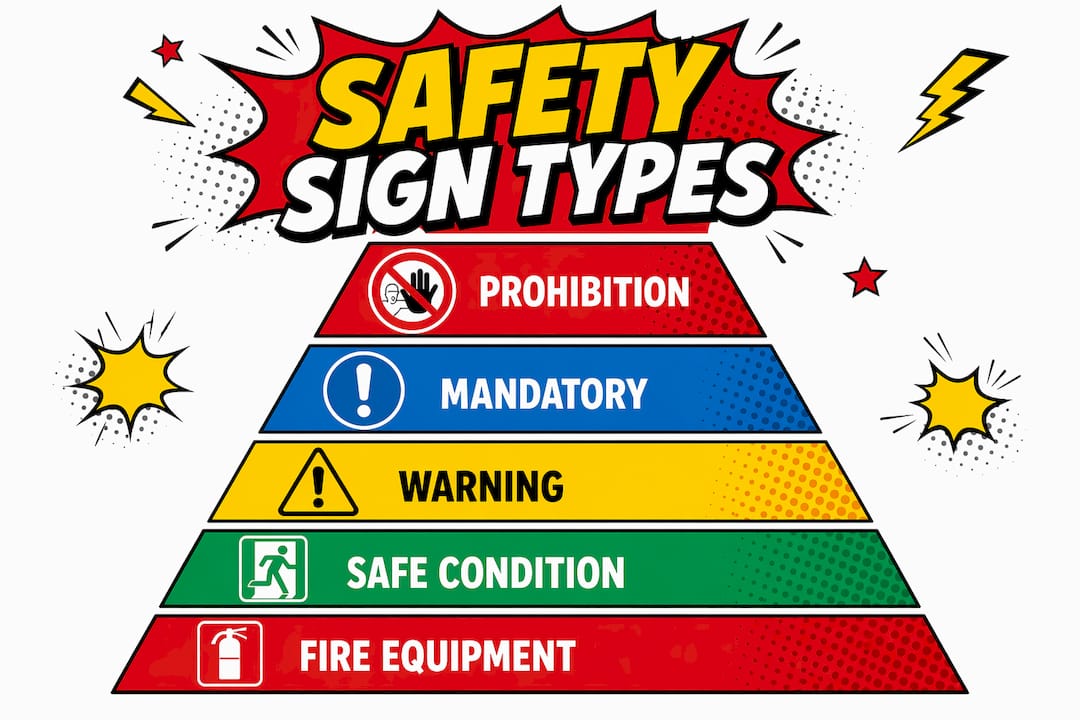
The five categories of health and safety signs each carry a distinct meaning, communicated through a combination of colour, shape, and pictogram. Understanding these categories is the foundation of any compliant signage system.
| Category | Colour | Shape | Purpose | Example |
|---|---|---|---|---|
| Prohibition | Red and white | Circle with diagonal bar | Forbids a specific action | No smoking, no entry |
| Mandatory | Blue and white | Solid circle | Requires a specific action | Wear ear protection, use hard hat |
| Warning | Yellow and black | Triangle | Alerts to a hazard | Electrical hazard, slippery floor |
| Safe condition | Green and white | Rectangle or square | Indicates safety routes or facilities | Fire exit, first aid point |
| Fire equipment | Red and white | Rectangle or square | Identifies firefighting equipment | Fire extinguisher, fire hose reel |
ISO 7010 standardises these pictograms internationally, specifying precise graphical codes, colours, and shapes to unify signage across borders. This matters for any UK business with international operations, suppliers, or a workforce trained in other countries.
A few points worth noting about colour conventions:
- Red signals prohibition or fire equipment, never a general warning.
- Yellow or amber signals caution and is reserved for hazard warnings.
- Blue signals a mandatory requirement, not a suggestion.
- Green signals safety, safe routes, and first aid.
Pro Tip: Never mix categories on a single sign. A blue circle with a warning triangle creates confusion and may invalidate the sign’s legal standing. Each sign must belong clearly to one category.
For businesses operating on construction sites, the types of construction signage follow these same five categories but with additional site-specific requirements around exclusion zones, plant movement, and PPE (Personal Protective Equipment) mandates.
How to design and place signage that actually works
Effective health and safety signage is not simply about buying the correct category of sign. Placement, legibility, and maintenance determine whether a sign does its job or becomes invisible background noise.
- Place signs at the point of risk. A warning sign for a wet floor belongs at the entrance to the wet area, not ten metres away. Signs placed too early or too late lose their effectiveness entirely.
- Ensure legibility at the relevant viewing distance. The HSE recommends that sign size corresponds to the distance from which it must be read. A sign visible from five metres requires a minimum height of 200mm for the pictogram.
- Use pictograms as the primary communication tool. Experts recommend pictogram-based ISO 3864-1 compliant signs for maximum comprehension across diverse workforces. Text can supplement but should never replace the pictogram.
- Avoid sign clutter. Displaying too many signs in one location causes workers to stop reading them. Prioritise the most critical hazards and remove signs that no longer apply.
- Inspect and maintain signs regularly. Faded, damaged, or obscured signs are not legally compliant. Schedule quarterly inspections as a minimum and replace deteriorated signs immediately.
- Train your workforce. Employers must train employees on sign meanings, particularly in multilingual workplaces where pictograms alone may not guarantee full understanding. Training records should be kept as evidence of compliance.
Pro Tip: When you install new signage, photograph each sign in situ and log the date. This creates a simple audit trail that demonstrates compliance during HSE inspections or insurance reviews.
For a detailed breakdown of UK compliance requirements, including which signs are mandatory for specific industries, Pikpikpow’s compliance guide covers the full regulatory framework.
How do UK regulations compare with international standards?
The UK Health and Safety (Safety Signs and Signals) Regulations 1996 align closely with ISO 7010, the international standard that governs pictogram design, colour coding, and sign categories. This alignment means that a UK-compliant signage system is broadly compatible with signage requirements across the European Union and many other jurisdictions.
The significant divergence occurs with the United States, where OSHA (Occupational Safety and Health Administration) and ANSI (American National Standards Institute) favour a text-heavy approach. Multinational compliance challenges arise because OSHA/ANSI signs use severity-based colour systems and rely heavily on written warnings, whereas ISO 7010 prioritises pictograms with colour coding tied to sign category rather than hazard severity.
| Standard | Jurisdiction | Approach | Colour logic |
|---|---|---|---|
| HSE / SI 1996 No. 341 | United Kingdom | Pictogram-led, ISO-aligned | Category-based (red, blue, yellow, green) |
| ISO 7010 | International | Pictogram-led | Category-based (red, blue, yellow, green) |
| OSHA / ANSI Z535 | United States | Text-heavy, pictogram secondary | Severity-based (danger red, warning orange, caution yellow) |
| AS 1319 | Australia | Pictogram and text combined | Broadly ISO-aligned with local variations |
Multinational firms reduce compliance risk by adopting ISO 7010 as their corporate baseline and overlaying jurisdiction-specific text requirements as needed. This approach avoids the cost of maintaining entirely separate signage systems for each country of operation.
For UK businesses with no international operations, the practical takeaway is straightforward. Specify ISO 7010 compliant signs and you satisfy both UK HSE requirements and the expectations of any international auditor, insurer, or client visiting your site.
Key takeaways
Health and safety signage is a legally required, pictogram-based communication system that reduces workplace accidents by conveying hazard and safety information instantly across language and cultural barriers.
| Point | Details |
|---|---|
| Legal requirement | UK employers must display signs wherever significant risks remain after other controls are applied. |
| Five sign categories | Prohibition, mandatory, warning, safe condition, and fire equipment signs each use distinct colours and shapes. |
| ISO 7010 alignment | UK regulations align with ISO 7010, making compliant signs broadly compatible with international standards. |
| Training is mandatory | Employers must train staff on sign meanings, particularly in multilingual workplaces, to satisfy legal obligations. |
| Maintenance matters | Regular inspection and replacement of faded or damaged signs is a compliance requirement, not optional housekeeping. |
Our view on signage as a safety system, not a safety shortcut
At Pikpikpow, we have worked with businesses across construction, retail, and commercial interiors on signage projects where the brief starts as “we just need a few signs for compliance.” That framing almost always leads to underinvestment and, eventually, a problem.
The businesses that get signage right treat it as a system, not a collection of individual signs. They map their sites, identify every residual risk, specify the correct sign category for each hazard, and then review the whole system when processes or layouts change. A visible and consistently implemented signage system demonstrates management’s commitment to employee wellbeing and strengthens trust and morale. That is not a soft benefit. It is measurable in reduced incident rates and lower staff turnover.
The other mistake we see regularly is treating signage and training as separate workstreams. Signs without training are incomplete. A worker who does not know that a blue circle means a mandatory requirement will not respond to it correctly, regardless of how well-made the sign is. The two must be implemented together.
One more observation: aesthetics matter more than most safety managers admit. A sign that is poorly printed, warped, or faded does not just fail legally. It signals to your workforce that safety is not genuinely prioritised. High-quality, durable signs communicate the same message as the hazard warning they carry: this organisation takes this seriously.
— PikPikPOW!
Get compliant, durable health and safety signage from Pikpikpow
If you are reviewing your workplace signage or building a system from scratch, Pikpikpow produces bespoke health and safety signs that meet UK HSE requirements and ISO 7010 standards. Every sign is manufactured to last, using materials suited to indoor and outdoor environments across construction, retail, and commercial settings.
Whether you need a single mandatory sign or a complete signage system covering an entire facility, Pikpikpow combines design expertise with precision manufacturing to deliver signs that are legible, durable, and fully compliant. The team also offers guidance on sign placement and category selection, so you are not left guessing whether your site meets its legal obligations. Visit the health and safety signage page to explore the full range and request a quote tailored to your site.
FAQ
What is health and safety signage?
Health and safety signage is the standardised system of workplace signs that communicates hazards, mandatory actions, and emergency information using specific colours, shapes, and pictograms. In the UK, these signs are governed by the Health and Safety (Safety Signs and Signals) Regulations 1996.
When are employers legally required to display safety signs?
Safety signs are legally required only when significant risks remain after all other control measures, such as engineering controls and safe working procedures, have been applied. Signs are the last layer of protection, not a replacement for hazard removal.
What are the five types of safety signs?
The five categories are prohibition (red circle), mandatory (blue circle), warning (yellow triangle), safe condition (green rectangle), and fire equipment (red rectangle). Each category uses a distinct colour and shape to communicate its meaning without relying on text.
Does UK signage comply with international standards?
UK signage regulations align closely with ISO 7010, the international pictogram standard, making UK-compliant signs broadly compatible with requirements across the EU and many other countries. The main divergence is with the US OSHA/ANSI system, which uses a text-heavy, severity-based approach.
Do employees need training on safety sign meanings?
Yes. Employers have a legal obligation to train employees on sign meanings, particularly in multilingual workplaces where pictograms alone may not guarantee full understanding. Training records should be maintained as evidence of compliance.