

TL;DR:
- Environmental graphics influence how people navigate, feel, and connect with physical spaces.
- Early collaborative design and user testing are essential for effective environmental graphic implementation.
- Modern trends include digital integration, sustainability, and immersive experiences to enhance brand communication.
Physical spaces communicate your brand whether you plan them to or not. Every wall, corridor, and entrance sends a message to visitors, customers, and employees. Yet most businesses invest heavily in digital marketing and logos while leaving their physical environments to chance. Environmental graphics change that. This discipline shapes how people navigate, feel, and connect with your space, and the results go far beyond aesthetics. If you operate in retail, construction, or corporate environments, understanding environmental graphics could be one of the most impactful decisions you make for your brand in 2026.
Table of Contents
- Defining environmental graphics
- Core methodologies and best practices
- Applications across sectors: Retail, construction, and corporate spaces
- Modern trends: From sustainability to experiential graphics
- Why most businesses underestimate environmental graphics
- Enhance your space with environmental graphics expertise
- Frequently asked questions
Key Takeaways
| Point | Details |
|---|---|
| Blends design and space | Environmental graphics integrate graphic design with architectural and interior elements to enrich brand presence and navigation. |
| Improves user experience | Effective EGD guides, engages, and delights visitors while supporting accessibility and sustainability. |
| Sector-spanning impact | Retail, corporate, and construction sectors all gain measurable benefits from strategic environmental graphics. |
| Sustainability and technology | Modern trends prioritise eco-friendly materials and digital experiences for future-proofed environments. |
Defining environmental graphics
Environmental graphics is the practice of using visual communication to shape how people experience a physical space. It is sometimes called Environmental Graphic Design, or EGD, and it sits at the crossroads of graphic design, architecture, interior design, and technology. The goal is not simply to decorate a space. It is to make that space work harder for your brand and your users.
Environmental Graphic Design (EGD) is a multidisciplinary practice integrating graphic design, architecture, interior design, and technology to enhance navigation, branding, and user experiences in physical spaces through elements like wayfinding signage, murals, placemaking graphics, and digital displays.
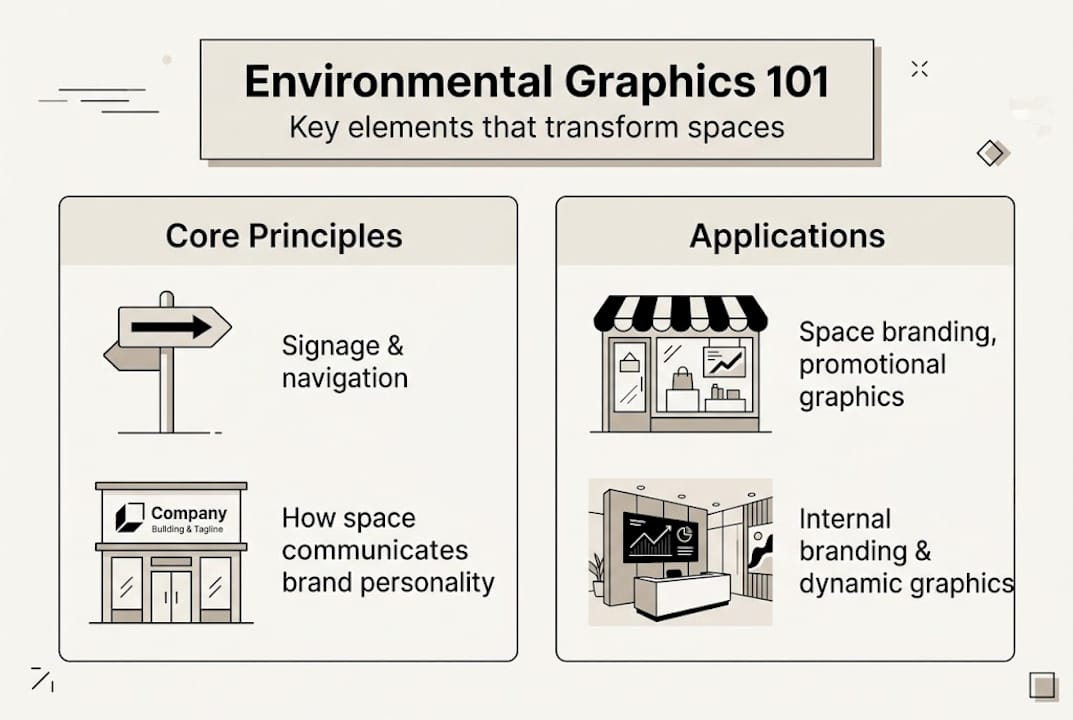
You can explore how this applies in practice through our environmental graphics overview, which covers the full range of solutions available for business environments.
EGD typically encompasses four core pillars:
- Navigation: Helping people move through a space confidently and efficiently
- Placemaking: Creating a sense of identity and belonging within a physical environment
- Brand expression: Translating your visual identity into three-dimensional space
- Information design: Presenting content clearly so users can act on it quickly
These pillars work together to create spaces that feel intentional rather than accidental. The difference is noticeable immediately.
Here is a quick comparison of what EGD covers versus what most businesses currently invest in:
| Element | Traditional approach | EGD approach |
|---|---|---|
| Signage | Basic directional signs | Integrated wayfinding systems |
| Walls | Painted or plain | Branded murals and graphics |
| Entrances | Functional only | Brand experience moments |
| Digital screens | Standalone displays | Data-driven, contextual content |
| Floor space | Unmarked | Placemaking and zoning graphics |
Research into user experience in built environments consistently shows that spatial design influences behaviour, mood, and decision-making far more than most business owners realise. When your physical space aligns with your brand values, customers trust you more. Employees feel more engaged. Visitors find their way without frustration.
EGD is not a luxury reserved for large corporations. It is a practical tool for any business that wants its physical environment to support its commercial goals.
Core methodologies and best practices
Now that you understand what environmental graphics are, let us examine how they are crafted for maximum impact.
Successful EGD does not happen by adding graphics at the end of a fit-out. Core methodologies involve early collaborative integration with architects and interiors teams, user-centred design processes including audience analysis, prototyping, testing, and iteration. Starting late means retrofitting, which costs more and delivers less.
Here is a practical step-by-step approach to implementing EGD effectively:
- Define your audience: Who uses this space? Customers, employees, visitors, or all three? Each group has different needs.
- Map user journeys: Trace the paths people take through your space and identify friction points or missed brand opportunities.
- Collaborate early: Bring your EGD specialist in at the same time as your architect or interior designer, not after.
- Prototype and test: Before committing to full installation, test key elements with real users to validate decisions.
- Ensure accessibility: Design for all users, including those with visual impairments or language barriers.
- Plan for sustainability: Choose materials and processes that align with your environmental commitments.
- Review and iterate: EGD is not a one-time project. Spaces evolve, and your graphics should too.
Why does EGD matter for every project type? Because every built environment is a communication opportunity. A retail store that guides customers naturally to key products increases conversion. A corporate office that reflects company values improves staff retention.
For businesses investing in architectural signage, integrating EGD thinking from the outset ensures that every element contributes to a coherent experience rather than a collection of disconnected signs. Similarly, internal and wayfinding signage becomes far more effective when it is designed as part of a broader spatial strategy.
Pro Tip: Before committing to full-scale installation, run a simple user test with five to ten real visitors. Ask them to complete a task, such as finding a specific department or exit, without assistance. Their behaviour will reveal gaps no designer can spot from a floor plan alone.
Applications across sectors: Retail, construction, and corporate spaces
Understanding the process is excellent; seeing its value in practical situations is even better.
Environmental graphics serve different but equally important functions depending on your sector. Here is how they apply across the three key areas:
Retail environments use EGD to guide customers through the store, highlight promotions, reinforce brand identity, and create memorable in-store experiences. Graphics at eye level, floor decals, window displays, and feature walls all contribute to a journey that feels curated rather than chaotic.
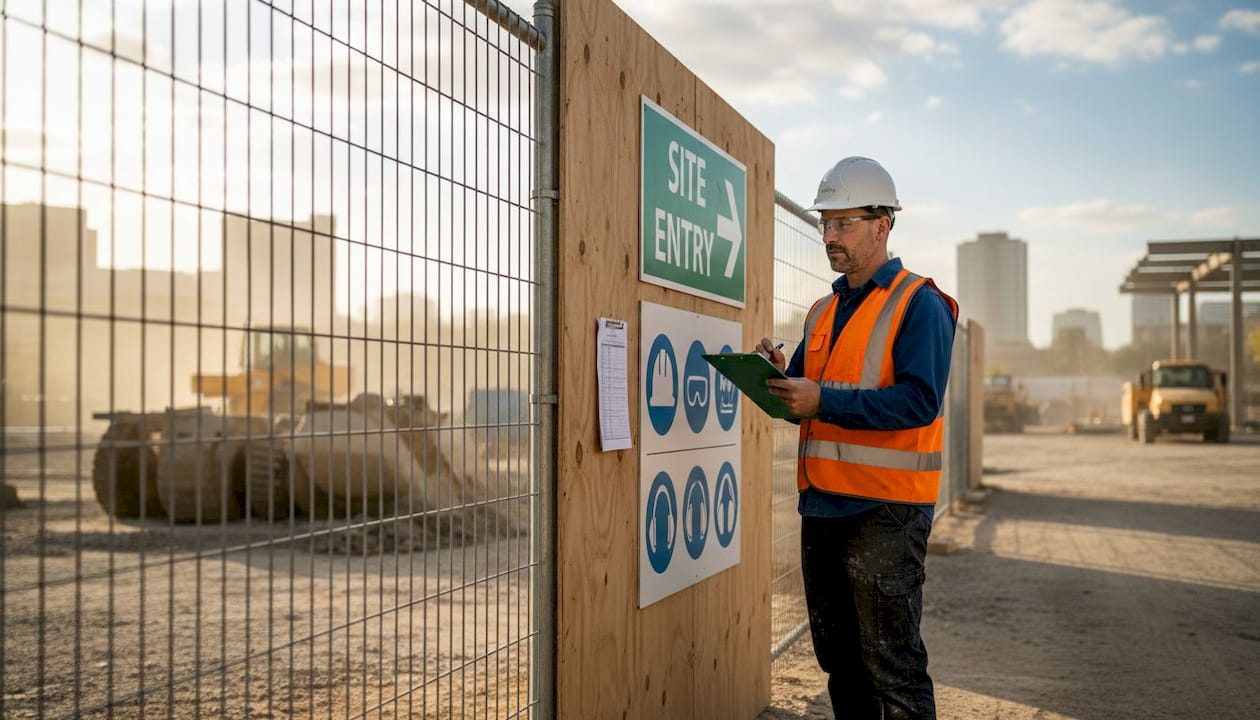
Construction sites rely on environmental graphics for compliance, safety, and brand visibility. Hoarding graphics, safety signage, and site identification boards communicate professionalism to the public while meeting legal requirements. Our construction site signage guide covers the compliance and safety requirements in detail.
Corporate spaces use EGD to embed company culture into the physical workplace. Values printed on feature walls, branded meeting rooms, and clear wayfinding signage all contribute to an environment where employees and visitors feel the brand rather than just seeing a logo.
Here is a comparison of EGD priorities across sectors:
| Sector | Primary EGD goal | Key elements |
|---|---|---|
| Retail | Conversion and experience | Floor graphics, murals, display signage |
| Construction | Safety and compliance | Hoarding, safety boards, site ID |
| Corporate | Culture and navigation | Wayfinding, branded interiors, digital |
Edge cases are worth noting. Complex large-scale spaces such as hospitals and campuses require intuitive systems, ADA and multilingual compliance, retrofitting into existing buildings, and balancing bold creativity with engineering practicality, plus digital integration challenges like ongoing maintenance.
Key benefits across all sectors include:
- Reduced customer confusion and frustration
- Stronger brand recall after a visit
- Improved staff orientation and productivity
- Greater compliance with safety regulations
- Enhanced perception of professionalism and quality
For current EGD trends shaping how businesses approach these applications, the shift toward experiential and digital integration is particularly relevant for forward-thinking organisations.
Modern trends: From sustainability to experiential graphics
While traditional approaches achieve a lot, modern trends are taking environmental graphics even further.
The field is evolving rapidly. What was once a discipline focused on static signs and printed murals is now incorporating technology, sustainability, and sensory engagement in ways that create genuinely memorable environments.
According to research on EGD and user experience, the field is evolving from Environmental Graphic Design to Experiential Graphic Design, or XGD, with a more immersive and interactive focus incorporating augmented reality and digital displays. Sustainability is advancing through recycled materials and low-VOC processes, while biophilic, minimalist, and hyperlocal design trends are gaining traction. Data-driven approaches using heatmaps are also emerging to inform spatial decisions.
Here is what this means in practice for your business:
- Augmented reality overlays: Visitors use smartphones to access additional brand content layered over physical spaces
- Digital display integration: Screens embedded within graphic systems deliver dynamic, updatable content
- Biophilic design elements: Natural textures, plant integration, and organic forms create calming, engaging environments
- Hyperlocal storytelling: Graphics that reflect the specific community, history, or culture of a location
- Data-informed placement: Heatmap analysis identifies where graphics will have the most impact based on actual foot traffic patterns
Sustainability is no longer optional for most businesses. Clients and customers increasingly expect responsible material choices. Our eco solvent printing approach addresses this directly, using processes that reduce environmental impact without compromising on quality or durability.
For emerging EGD trends in 2026, the most significant shift is the move from purely informational graphics toward emotionally resonant experiences. Businesses that embrace this shift will create spaces that people genuinely want to spend time in, and talk about afterwards.
Pro Tip: If you are planning a refurbishment or new fit-out, request a sustainability brief from your signage supplier. Ask specifically about recycled substrates, low-VOC inks, and end-of-life disposal options. These details matter to your customers and increasingly to planning authorities.
Why most businesses underestimate environmental graphics
Most businesses treat environmental graphics as a finishing touch rather than a strategic foundation. That is a costly mistake. By the time a fit-out is complete and the budget is spent, there is rarely appetite to revisit the walls, floors, and ceilings with fresh eyes. Graphics get added quickly and cheaply, and the opportunity is lost.
The businesses that get this right treat EGD as a discipline equal in importance to interior design or brand strategy. They involve specialists early, invest in user testing, and think about inclusivity from the outset rather than retrofitting accessibility as an afterthought.
What is consistently missed is the user journey. Most decision-makers think about how a space looks in photographs. Real users experience it in motion, under pressure, often without context. Designing for that reality requires a different mindset, one that prioritises function and feeling over visual impressiveness alone.
If your space is not working as hard as your website or your marketing materials, it is time to reconsider how you approach environmental graphics.
Enhance your space with environmental graphics expertise
At Pik Pik POW!, we work with businesses across retail, construction, and corporate sectors to design and deliver environmental graphics that genuinely perform. From concept through to installation, our team combines design expertise with precision manufacturing to create spaces that reflect your brand at every touchpoint.
Whether you need digital signage solutions for dynamic content delivery or fully integrated signage systems that cover wayfinding, branding, and compliance, we can help you build an environment that works. Get in touch with our team to discuss your project and find out how we can translate the principles in this article into real results for your business.
Frequently asked questions
What is the difference between environmental graphics and traditional signage?
Environmental graphics encompass overall spatial branding and user experience, using a multidisciplinary approach to enhance the entire space. Traditional signage typically focuses solely on information delivery or basic navigation, without the broader strategic intent of EGD.
What are common materials used for sustainable environmental graphics?
Sustainable environmental graphics commonly use recycled material substrates, low-VOC inks, and eco-friendly printing processes. These choices are now standard in advanced EGD and XGD projects where environmental responsibility is a client requirement.
How do environmental graphics support accessibility in public spaces?
They improve wayfinding through clear visual hierarchies, incorporate multilingual text, and follow ADA-compliant design standards. EGD best practice treats accessibility as a core requirement rather than an optional addition.
Can environmental graphics be retrofitted into existing buildings?
Yes, EGD solutions can be applied to existing facilities as overlays or modular enhancements without requiring full structural changes. Retrofitting EGD into older buildings is common practice and often delivers significant improvements to user experience at a manageable cost.