
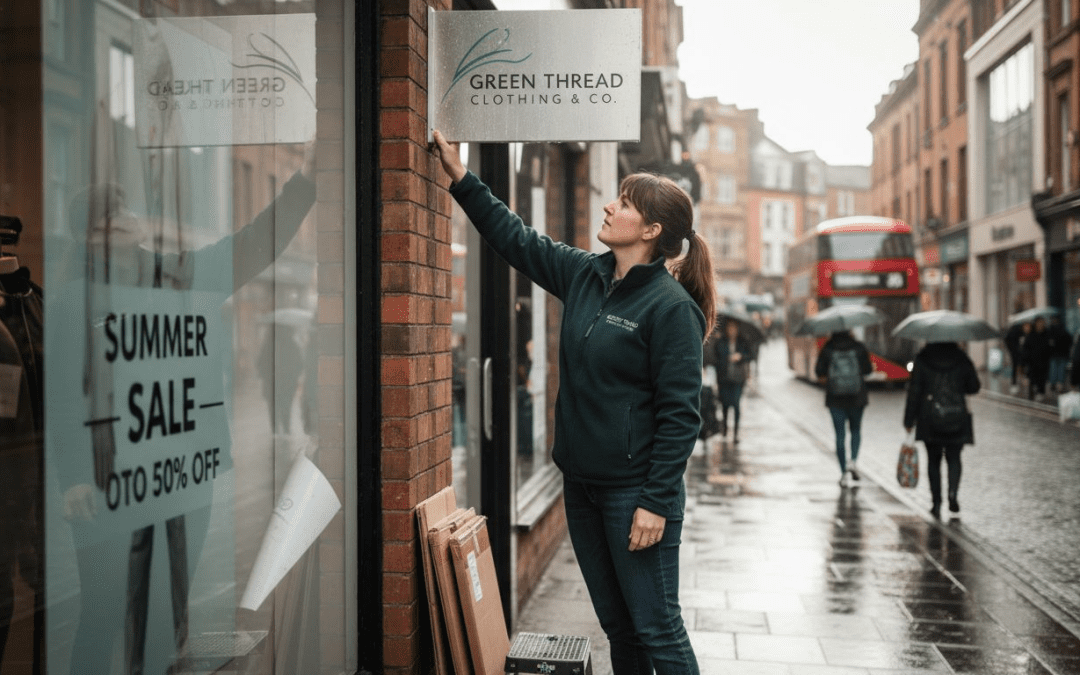
Standing in a busy United Kingdom retail environment, the right signage can mean the difference between an unnoticed store and one that draws customers in from the high street. For marketing managers, understanding how effective signage supports key objectives like brand visibility and customer engagement is crucial. This guide will help you pinpoint exactly what your brand needs by exploring strategies that combine creative design with practical durability for signage solutions that make your retail space stand out.
Table of Contents
- Step 1: Identify Brand Objectives And Signage Needs
- Step 2: Select Materials And Formats For Durability
- Step 3: Develop Artwork And Messaging For Impact
- Step 4: Collaborate On Manufacturing And Installation
- Step 5: Verify Quality And Branding On Completed Signage
Quick Summary
| Key Point | Explanation |
|---|---|
| 1. Understand brand objectives clearly | Identifying core objectives will guide your signage design, ensuring alignment with overall marketing goals. |
| 2. Choose durable materials wisely | Selecting suitable materials ensures longevity and effective presentation in retail environments. |
| 3. Craft impactful artwork and messaging | Use strong visuals and clear text to create engaging signage that captures customer attention quickly. |
| 4. Collaborate effectively for execution | Successful signage implementation relies on good team coordination across design, manufacturing, and installation. |
| 5. Conduct thorough quality verification | Systematic inspection of completed signage ensures brand consistency and high standards are maintained. |
Step 1: Identify brand objectives and signage needs
Designing effective signage for UK retail chains requires a strategic approach that transforms visual communication into a powerful marketing tool. When developing signage solutions, you must first understand the core brand objectives that will drive your design decisions.
Your signage strategy should focus on several key elements that support your broader marketing goals. Key retail signage objectives typically include:
- Increasing brand visibility and recognition
- Driving sales and customer engagement
- Improving in-store customer navigation
- Creating a consistent brand experience
- Communicating promotional messages effectively
To achieve these objectives, retailers need to evaluate different signage types that align with their specific needs. This involves considering various formats such as exterior signs, interior wayfinding, persuasive marketing displays, and digital communication channels.
The selection process requires careful analysis of your brand’s unique requirements. Consider factors like store layout, target demographic, brand aesthetic, and budget constraints when determining the most appropriate signage solutions.
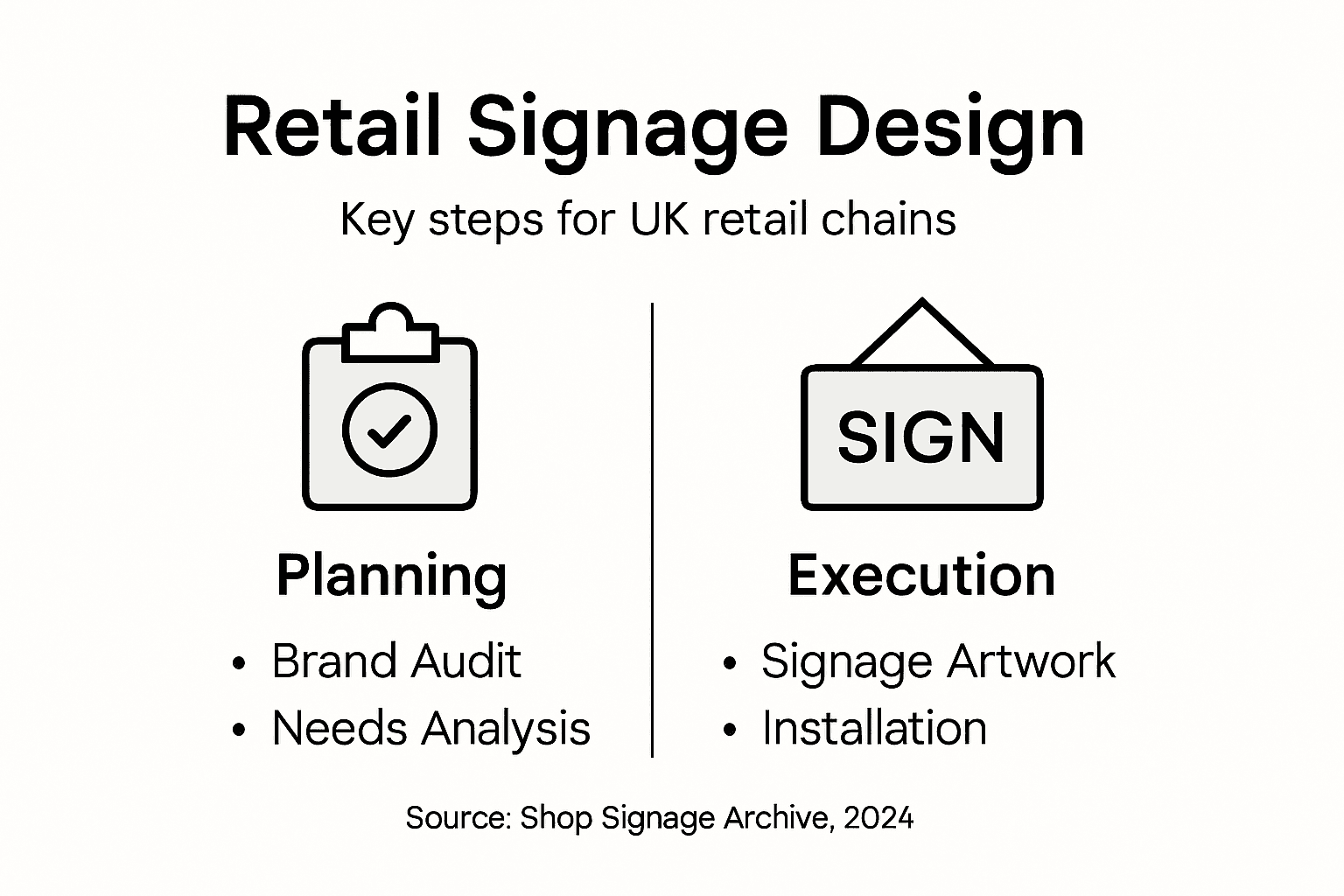
Here’s how common signage types suit different retail purposes:
| Signage Type | Ideal Location | Main Advantage |
|---|---|---|
| Exterior shop front | Outdoor entrance | Boosts visibility and attracts footfall |
| Interior wayfinding | Store corridors | Enhances customer navigation |
| Promotional displays | Product aisles | Increases sales and highlights offers |
| Digital screens | Reception/lounge | Enables dynamic and real-time messaging |
| Illuminated signs | Window/front | Improves visibility in low-light conditions |
Effective signage acts as a silent salesperson, communicating your brand’s value proposition without saying a word.
Top tip: Conduct a comprehensive brand audit before designing signage to ensure every visual element authentically represents your retail chain’s identity and strategic goals.
Step 2: Select materials and formats for durability
Choosing the right materials and formats for retail signage is crucial for creating long-lasting, impactful visual communications that withstand the demanding environment of modern retail spaces. Your selection will directly influence the sign’s performance, aesthetic appeal, and overall effectiveness.
When considering materials for retail signage, you’ll need to evaluate several key characteristics:
- Weather resistance for exterior signs
- Impact durability in high-traffic areas
- Colour retention and UV stability
- Maintenance requirements
- Cost-effectiveness of different material options
Different signage formats offer unique advantages for various retail environments. Acrylic signs provide a sleek, professional appearance and excellent durability, while aluminium composite panels offer lightweight strength for larger displays. Perspex materials work brilliantly for illuminated signage, creating crisp, vibrant visual communications.
High-quality materials are an investment in your brand’s visual presentation and long-term communication strategy.
Retail chains should also consider additional factors such as installation complexity, potential environmental challenges, and the specific functional requirements of each signage location. Outdoor signs, for instance, demand more robust materials compared to interior wayfinding displays.
A quick comparison of retail signage materials and their benefits:
| Material | Durability Level | Maintenance Needs | Typical Usage |
|---|---|---|---|
| Acrylic | High | Low | Shop front and promotional |
| Aluminium composite | Very high | Minimal | Large exterior signs |
| Perspex | High | Moderate | Illuminated indoor signage |
| Corrugated plastic | Moderate | Easy | Temporary promotions |
| Stainless steel | Exceptional | Requires cleaning | Premium brand environments |
Pro tip: Always request material samples and conduct durability testing before committing to large-scale signage production to ensure optimal performance and appearance.
Step 3: Develop artwork and messaging for impact
Creating compelling artwork and messaging is the heart of effective retail signage, transforming simple visual communication into a powerful brand storytelling tool. Your design must capture attention, convey key messages, and ultimately drive customer engagement within seconds of being viewed.
When developing your signage artwork, focus on these critical design elements:
- Colour psychology and brand alignment
- Typography that enhances readability
- Visual hierarchy to guide viewer attention
- Consistent brand imagery
- Clear, concise messaging
Designing impactful signage requires a strategic approach. Shopfront signage ideas can help retailers create visuals that not only communicate information but also create an emotional connection with potential customers. Your messaging should be crisp, memorable, and aligned with your brand’s core values.
Effective signage speaks volumes without saying too much – it’s about creating a visual language that resonates instantly.
Consider the viewing distance, lighting conditions, and audience demographics when crafting your design. Larger text, high-contrast colour schemes, and simple, bold graphics tend to work best in retail environments where customers are often moving quickly.

Pro tip: Test your signage design by viewing it from various distances and angles, ensuring it remains clear and impactful in real-world conditions.
Step 4: Collaborate on manufacturing and installation
Successful signage implementation requires seamless collaboration between your design team, manufacturers, and installation professionals. This critical phase transforms your creative vision into a tangible, professionally executed visual communication strategy that represents your brand effectively.
When collaborating on manufacturing and installation, focus on these key coordination points:
- Project timeline management
- Technical specifications alignment
- Quality control checkpoints
- Installation site preparation
- Final sign-off procedures
Shop signage installation guide highlights the importance of clear communication between all stakeholders. Your manufacturing partner should receive comprehensive design files, precise measurements, and explicit brand guidelines to ensure accurate reproduction of your visual concept.
Effective collaboration is the bridge between creative design and flawless execution.
Carefully review material samples, colour proofs, and prototype designs before full production. This approach minimises potential errors and ensures your signage meets exact brand standards. Consider scheduling multiple review stages where key decision-makers can provide input and approve progression.
Pro tip: Create a detailed project brief that includes comprehensive technical specifications, brand guidelines, and expected outcomes to facilitate smoother manufacturing and installation processes.
Step 5: Verify quality and branding on completed signage
The final stage of signage production demands meticulous attention to detail, ensuring that every visual element perfectly represents your brand’s identity and professional standards. Verification is not just a formality but a critical quality control process that safeguards your brand’s reputation.
When reviewing completed signage, systematically assess these key aspects:
- Colour accuracy against brand guidelines
- Material finish and surface quality
- Typography and graphic element precision
- Dimensional accuracy of sign components
- Installation alignment and positioning
Design impact on signage demonstrates how even minor inconsistencies can significantly undermine your brand’s visual messaging. Conduct a comprehensive inspection that goes beyond surface-level assessment, examining every detail with a critical eye.
Quality is not an act, but a habit that distinguishes exceptional brands from ordinary ones.
Document your verification process thoroughly, creating a detailed checklist that captures each aspect of brand compliance. This approach not only ensures consistency but also provides a valuable reference for future signage projects, helping to maintain high standards across all brand communications.
Pro tip: Photograph completed signage under various lighting conditions and from multiple angles to capture potential imperfections that might be missed during initial inspection.
Elevate Your Retail Signage with Expert Design and Durable Solutions
Designing signage for UK retail chains demands attention to brand objectives, material durability and impactful messaging. If you are looking to overcome challenges like maintaining brand consistency, ensuring long-lasting quality and capturing customer attention you need a partner who understands these nuances. At Pik Pik POW! we specialise in bespoke indoor and outdoor signage that aligns with your strategic goals while using premium materials and expert craftsmanship.
Unlock the full potential of your retail signage by exploring our extensive range of services on the Shop Signage Archives – Pik Pik Pow. See how our precise manufacturing and dynamic printing technology solutions combine to create standout visual communications that truly represent your brand. Don’t wait to transform your retail spaces into powerful marketing assets visit https://pikpikpow.co.uk today and start designing signage that delivers lasting impact.
Frequently Asked Questions
How can I identify my brand objectives for retail signage?
To identify your brand objectives, evaluate your overall marketing goals and consider what you want the signage to achieve. Focus on elements such as increasing brand visibility, driving sales, and improving in-store navigation. Conduct a brand audit to understand your retail chain’s unique needs.
What materials should I consider for long-lasting retail signage?
Choose materials based on durability, maintenance needs, and weather resistance. For exterior signs, materials like Aluminium Composite Panels or Acrylics are ideal due to their robustness. Evaluate the specific environment of your store to ensure optimal performance of your signage.
How should I develop effective artwork and messaging for my signage?
Create artwork and messaging that captures attention and aligns with your brand. Focus on clear, concise messaging, typography that enhances readability, and colour schemes that resonate emotionally with your audience. Test different designs at various distances for maximum impact.
What steps should I take to ensure proper installation of signage?
Ensure effective communication with your manufacturing and installation teams by developing a detailed project brief. This should include specifications, timelines, and quality control checkpoints. Schedule reviews during the process to verify that the installation meets brand standards.
How can I verify the quality of completed signage?
Conduct a thorough inspection of the signage, checking for colour accuracy, material finish, and typography precision. Create a detailed checklist to document your findings and take photographs under different lighting conditions to capture any potential imperfections.